Walk into any gym and you'll see both: foam rollers lined up against the wall and massage guns in the stretching area. They're both popular recovery tools, but they work in very different ways, and knowing the difference helps you pick the right one for the job.
This isn't about declaring a winner and tossing the other. It's about knowing what each tool does well, where it falls short, and how to use both.
How a Foam Roller Works
A foam roller is a simple cylinder. You lie on it and use your own body weight to roll slowly over a muscle, applying broad, steady pressure. It's a staple of warm-ups and cooldowns for good reason: it's cheap, quiet and easy to learn.
Foam Roller: Pros
- Low cost (a quality roller runs $15-40)
- No batteries or charging required
- Good for large muscle groups like quads, hamstrings and calves
- Fits easily into a warm-up or cooldown
- Quiet and simple to use
Foam Roller: Cons
- Hard to focus on a small, specific spot
- Needs floor space and some awkward positions (not ideal in a busy gym)
- Hard to use on your own back, neck and shoulders
- Pressure is limited to your body weight
- A full-body session can take 15-20 minutes
How a Percussion Massage Gun Works
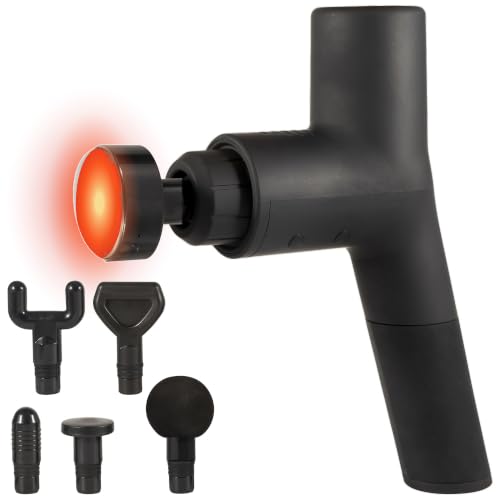
A percussion massage gun delivers rapid, concentrated pulses of pressure through an attachment head. The head moves in and out in short strokes (EXELLEON guns have 7 to 8 mm of amplitude) at speeds between 1,200 and 3,200 RPM, depending on the model and setting. Instead of rolling your body weight over a broad area, you hold the gun where you want it and let it do the work.
Massage Gun: Pros
- Precise: work exactly the spot you choose
- Reaches places a roller struggles with (back, shoulders, the back of the neck, feet)
- Quick: 2-3 minutes per muscle group
- Adjustable: several speed settings and attachment heads
- Portable: use it at the gym, at home or when traveling
- No floor space or special positions needed
Massage Gun: Cons
- Costs more up front than a foam roller
- Needs charging
- It's easy to overdo it, so start on a low speed and keep moving
- Noise level varies by model
Head-to-Head: When to Use Which
Use a Foam Roller When:
- You want a broad, general warm-up before training
- You're working large muscle groups (quads, hamstrings, calves)
- You want a low-cost option with zero maintenance
- You're somewhere quiet, like a hotel room
Use a Massage Gun When:
- You want to focus on one specific spot
- You're working your back, shoulders, the back of your neck or feet (never the front of the neck)
- Time is short
- You want to choose the speed and the head for each area
- You're on the go: gym bag, carry-on, locker room
Use Both When:
- You have the time: roll the large muscle groups first, then follow up with a massage gun on the spots you want to focus on.
The Verdict
Foam rollers aren't going anywhere. They're a solid, inexpensive tool for general warm-ups and cooldowns. A massage gun gives you more control: you pick the spot, the speed and the head.
If you had to choose one, think about where you want to use it. If reaching your own back is the main problem, the EXELLEON MGUN Massage Gun with Extension Handle has a detachable handle (about 13.2 in long with the handle on), so you can reach your own back without help.
For travel and gym bags, the EXELLEON MINIGUN Mini Massage Gun delivers 22 lb of stall force and weighs 0.74 lb, with a hard-shell zip case.
If you want the most options, the EXELLEON MUSCLEGUN Heated Massage Gun has 6 speed settings, 6 heads including a heated head (113 °F / 131 °F), and 180 to 240 minutes per charge.
Our Recommendation
Own both. Make a massage gun your main recovery tool, and keep a foam roller for warm-ups and light days. Between them, they cover most of what you'll need.
Recovery Starts Here
EXELLEON makes percussion massage guns (22 to 30 lb of stall force, depending on the model) and vibrating massage balls that run up to 4 hours per charge. Every product is USB-C rechargeable and comes with a 1-year warranty.